
Billing Invoices on MTN Cloud
Navigating billing and invoices can feel overwhelming, but this document is here to help you understand how MTN Cloud organises your costs.
To keep things simple, the Tenant Invoice — also referred to as Tenant-level cost aggregation — is the primary invoice to focus on. In this system, a Tenant is an isolated environment with its own users and workloads.
The Tenant Invoice serves as your primary consolidated bill, capturing your total spend for the month. For a more granular view, detailed cost breakdowns are available in the monthly Usage Report.
Understanding Your Invoice Details
The image below shows a customer tenant’s invoices across several months, displaying the month-to-date cost, end-of-month total, and the current month’s projected total cost.

When you select a tenant invoice, the dashboard provides complete transparency into your billing by breaking down exactly what makes up your costs.
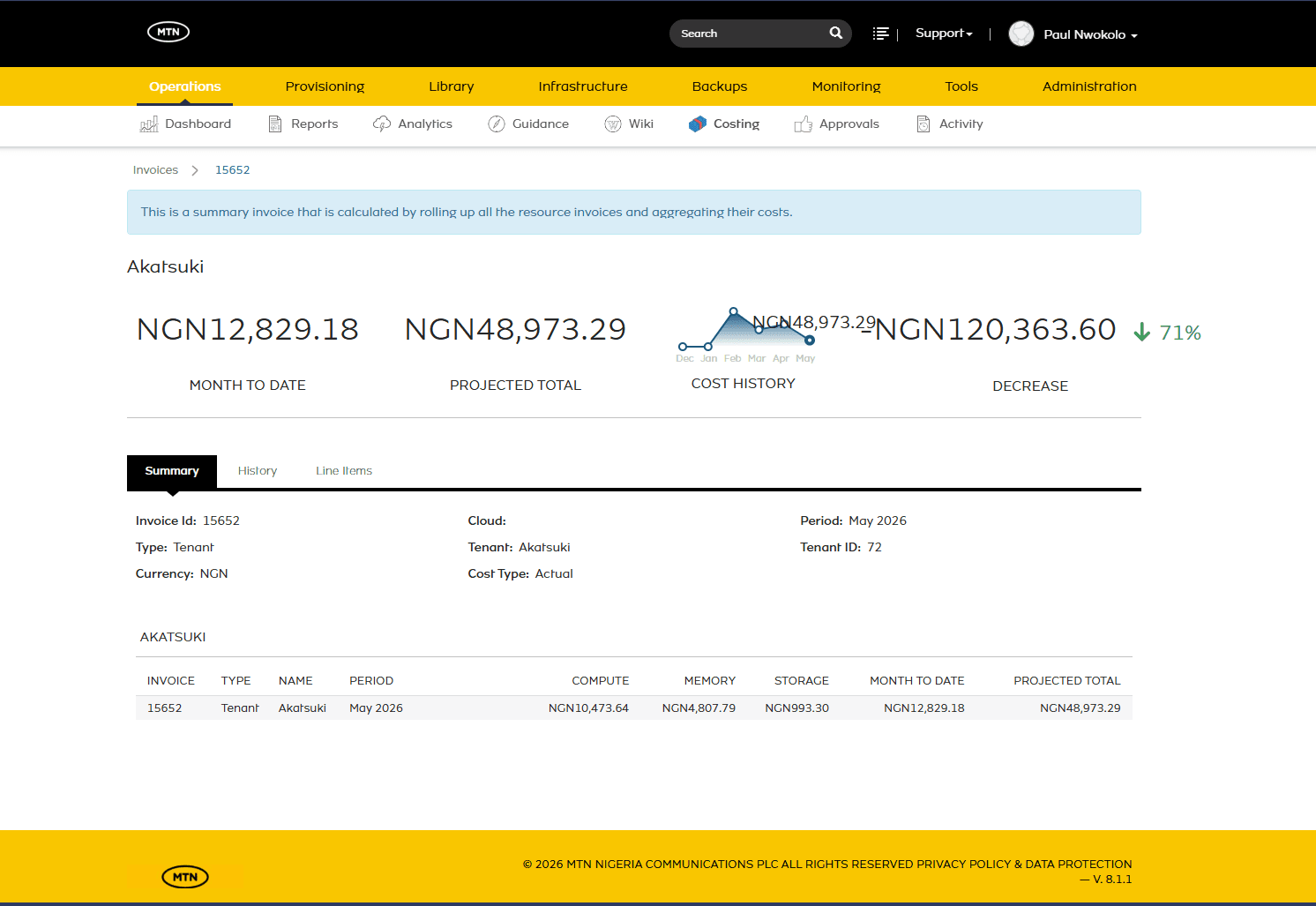
The invoice view is organised into three main tabs:
- Summary: Provides a high-level overview of the invoice, showing your month-to-date totals, projected final costs for the month, and a cost breakdown by category (such as compute, memory and storage).
- History: Displays your costs over time using visual graphs, making it easy to compare current spending against previous billing periods and identify significant changes.
- Line Items: Provides a complete, itemised list of every charge that makes up your invoice total, useful when you need to investigate specific costs in detail.
Additional Invoice Types
Quick Reminder: When viewing your Tenant Invoice on this screen, you are seeing the total for your entire environment. You may occasionally encounter more specific invoice types — such as Group or Instance invoices — which help track granular usage, but your Tenant Invoice remains your primary consolidated bill for the month.
While the Tenant Invoice gives you the big picture, MTN Cloud also generates a number of more granular invoice types. These are designed to help you break down costs in detail and forecast final monthly charges before the end of the billing period. You generally do not need to focus on these, as the broader invoice types already account for the costs captured in these narrower categories. They are available to provide deeper insight whenever you need to investigate a specific area of spending.
Below is a brief overview of these additional invoice types:
- Group Invoices: Aggregate costs for specific Groups, which manage user access to resources and Clouds.
- User Invoices: Aggregate costs for resources owned by an individual user during the billing period.
- Cloud Invoices: Represent costs associated with connections to any type of cloud environment (public, private, or hybrid) or bare metal server.
- Instance Invoices: Track costs for a single, horizontally scalable entity, typically a set of containers or virtual machines running a service.
- Server Invoices: Cover costs for an individual host, including virtual machines (VMs) or bare metal servers tracked by the system.
- Container Invoices: Break costs down to a single service node, which may be a VM or a Docker container within a managed Instance.
- Volume Invoices: Capture costs that can be tied directly to known storage volumes.
- Resource Invoices: A catch-all category for costs that cannot be assigned to any other specific resource type.
As long as you are reviewing your primary Tenant-level billing, you will always have a complete and accurate picture of your overall monthly costs.